The RDA for protein is 0.8 grams per kilogram of body weight a day. That figure is a minimum: it prevents deficiency in a sedentary adult, but it stops well short of the amount that supports muscle, healthy aging, or an active routine. How much you actually need depends on your body weight, your age, and how active you are. The table and questions below cover all three.
How much protein do you need per day?
The U.S. RDA is 0.8g of protein per kilogram of body weight per day. The government's Acceptable Macronutrient Distribution Range (AMDR) allows protein up to 35% of total daily calories, well above the RDA for most people[1]. Use the table below for your own target by body weight and activity level.
| Body weight |
RDA (0.8g/kg, minimum) |
Active range (1.2-1.6g/kg) |
Muscle-building range (1.4-2.0g/kg) |
| 55kg (120lb) |
44g |
66-88g |
77-110g |
| 70kg (154lb) |
56g |
84-112g |
98-140g |
| 90kg (198lb) |
72g |
108-144g |
126-180g |
The RDA is the number most people have heard. The two columns beside it are the ranges that apply once you exercise, lift, or want to hold onto muscle as you age.
How much protein do you need to build muscle?
Building or holding onto muscle takes roughly double to two-and-a-half times the RDA. That's the range the International Society of Sports Nutrition's position stand settles on: 1.4 to 2.0g/kg/day[2]. The table above converts that into daily grams for your own body weight. Spread the total across three to four meals; the section below on per-meal amounts covers why that matters.
How much protein do older adults need?
Muscle becomes harder to build and easier to lose after 65, so protein requirements climb with age instead of staying flat. The PROT-AGE Study Group, an international panel of aging and nutrition researchers, puts a number on that shift[3]:
-
Adults over 65: 1.0-1.2g/kg/day
-
Active older adults: 1.2g/kg/day or more
The intake that was adequate at 40 stops covering the requirement decades later.
Does plant protein count differently than animal protein?
The gram targets above are for total protein intake, and they don't change based on source. What differs is amino acid completeness at the ingredient level: a single plant protein can run short on one essential amino acid where an animal source doesn't. Blending complementary plant sources closes that gap. We combine pea, rice, and barley protein for exactly this reason, so the blend covers the amino acid profile a single plant source might miss on its own.
How much protein do you need per meal?
Muscle protein synthesis research settles around a working range, not one number:
-
25-40g per meal maximizes the response for most adults[4].
-
Older adults do better nearer the top of that range.
-
3-4 meals a day in that range beats getting the same daily total from one large meal.
That's the practical case for spreading protein through the day.
Can you eat too much protein?
For someone with healthy kidneys, intakes up to roughly 2-2.5g/kg/day are well studied and carry no established harm[2]. People with existing kidney disease are a real exception and should follow medical guidance over a general target. Outside of that, running short on protein is the more common problem than getting too much of it.
How much protein powder do you need to close the gap?
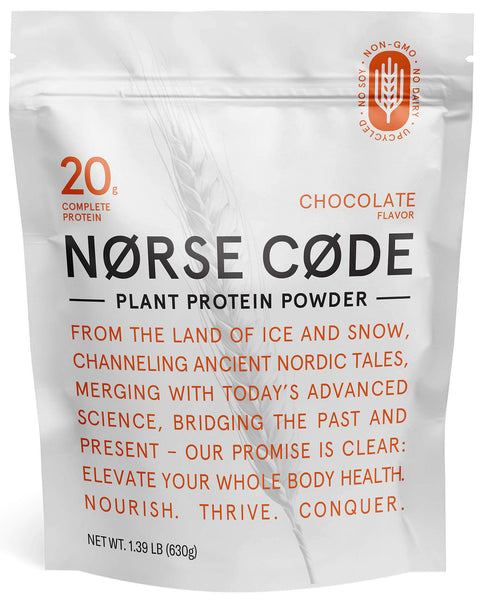
Most people fall short earlier in the day, at breakfast or lunch. One scoop mid-day usually closes that gap without changing every other meal. One scoop of NØRSE CØDE is 20g of protein from pea, rice, and barley protein, in 9 natural ingredients or less, with no artificial sweeteners, gums, or fillers. It mixes in any liquid with a spoon, hot or cold, no blender required. In a blind taste test, more people chose NØRSE CØDE than Orgain and Optimum Nutrition Gold Standard combined.
We third-party test every input for heavy metals. We also make it ourselves, in our own facility in Petaluma, California.
Sources
- [1] National Institutes of Health, Office of Dietary Supplements, and the Institute of Medicine's Dietary Reference Intakes: RDA of 0.8g protein/kg body weight/day; Acceptable Macronutrient Distribution Range of 10-35% of calories from protein.
- [2] Jäger R, Kerksick CM, Campbell BI, et al. "International Society of Sports Nutrition Position Stand: protein and exercise." Journal of the International Society of Sports Nutrition. 2017;14:20.
- [3] Bauer J, Biolo G, Cederholm T, et al. "Evidence-based recommendations for optimal dietary protein intake in older people: a position paper from the PROT-AGE Study Group." Journal of the American Medical Directors Association. 2013;14(8):542-559.
- [4] Moore DR. "Maximizing Post-exercise Anabolism: The Case for Relative Protein Intakes." Frontiers in Nutrition. 2019, on per-meal protein and muscle protein synthesis.
Talk to your doctor before changing your protein intake if you have kidney disease or another condition that affects protein metabolism.
Curious whether your own routine gets you there? A single scoop of NØRSE CØDE adds 20g toward whichever range above fits you, backed by a 60-day money-back guarantee, no questions asked.
Before you spend anything, two disclosures. It contains coconut, from the MCT oil. And barley protein is in the blend, so this is not the protein for you if you have celiac disease or a gluten sensitivity, and we would rather you heard that from us.
Ready to try it?
Backed by a 60-day money-back guarantee. If it is not the smoothest protein you have had, send it back.
Ready to try it?
Backed by a 60-day money-back guarantee. If it is not the smoothest protein you have had, send it back.
Shop NØRSE CØDE